A Tale of Two Realities: The Luminous Dream and Shadowed Workshop of Black Myth: Wukong
Explore the stunning yet turbulent journey of 'Black Myth: Wukong', a AAA game that blends ancient myth with modern ambition, revealing the hidden struggles behind its glossy facade.
I wander through a landscape painted in the hues of ancient myth and modern longing. Before me, a headless bard strums a lonely sanxian upon the gnarled root of a timeless tree, a solitary note in a vast, parched wilderness. Then, the sky fractures—cloaked figures descend like falcons upon a fleet-footed Sun Wukong, his path a crimson scar across the earth, leading to a derelict temple that holds its breath. This is the breathtaking vision that first seized the world’s imagination, a 13-minute pre-alpha dream from 2020 that promised a masterpiece. For a moment, we all stood in that field, feeling the weight of a cultural legacy re-forged in digital fire, believing we were witnessing the dawn of China’s AAA ascendance. The promise was a gemstone, polished to a blinding sheen by the hands of Game Science, an indie studio whose name became a whispered prayer among gamers. Yet, as I trace the contours of this dream, my fingers brush against a colder, rougher texture beneath the glossy surface—a workshop where the light casts long, troubling shadows.

The Forge of Ambition and Its Echoes
Founded in 2014 by exiles from Tencent’s halls, Game Science was born from a shared frustration—a desire to create without the chains of microtransactions that had, in their view, turned their previous project, Asura Online, into a hollow vessel. Their new venture, Black Myth: Wukong, was to be a phoenix risen from those ashes, a spiritual successor true to the dark, epic soul of Journey to the West. The studio's co-founder, Feng Ji, became its most vocal architect, a figure whose writings on game development were as passionate as they were pungent. He spoke of failed projects as "stillborn babies" and lamented the industry's struggles with a crude, visceral poetry. To some, this was the unfiltered passion of a true artisan; his words were like weathered tools in a master blacksmith's hands, unpolished but effective. Yet, this rhetorical style was not an isolated forge-fire. It seeped into the studio's culture, becoming a shared dialect that, over the years, would reveal a more troubling pattern.
The global crescendo of excitement for Wukong felt like a dam about to break. The 2020 trailer amassed millions of views overnight, a seismic event that shook the gaming world. Fans descended upon their Hangzhou studio with an almost religious fervor—one even broke in through a window on a weekend, a startling testament to the mythos they had created. In this fever dream, the studio was not just making a game; it was bearing a standard for a nation's creative pride. Yet, within this roaring tempest of acclaim, other, older whispers began to surface from the depths of the Chinese internet, carried on platforms like Weibo and Zhihu. They were fragments of a different story.
The Unseen Mosaic: A Pattern in the Shadows
As I pieced together these fragments, a mosaic emerged, one that depicted a studio environment where sexism was not an occasional lapse but a recurring motif in its foundational grout. The evidence was sprawling and decade-spanning:
-
The Founder's Quill: Feng Ji’s 2020 Weibo post celebrating the trailer's viral success was laced with graphic sexual innuendo, speaking of being "licked until I can't get an erection" and offering "comfort in the lower half of your body." He later commented that the trailer made him "wet" and spoke of "immense pressure" in his crotch. His defenders saw this as harmless, eccentric vulgarity—the ramblings of a genius lost in his craft, his crudeness a shield against corporate sterility.
-
Recruitment as Manifesto: From 2015, recruitment posters surfaced bearing messages like "Mandatory self-pleasure," "Don’t screw your colleagues," and the blunt "fatties should fuck off." These weren't hidden memes but public-facing calls for talent, framing the studio's identity in explicitly exclusionary and sexualized terms.
-
A Legacy from Tencent: Even before Game Science's founding, its core team, while at Tencent, produced an internal video joking about male employees becoming porn actors and rapists after a project failure, while female staff were depicted as hostesses and foot bath attendants.
-
The Artist's Dogma: Lead artist Yang Qi, in a 2013 post, elaborated on biological determinism in game design, claiming men dream of machine guns while women dream of enviable bags, concluding he'd need to wear silk stockings to create "soft and effeminate things."
-
The Latest Echo: In 2026, even as the game nears completion, a technical artist suggested on Zhihu that a female snake spirit character in Wukong could be masturbated to, "nurturing" a fetish for her design.
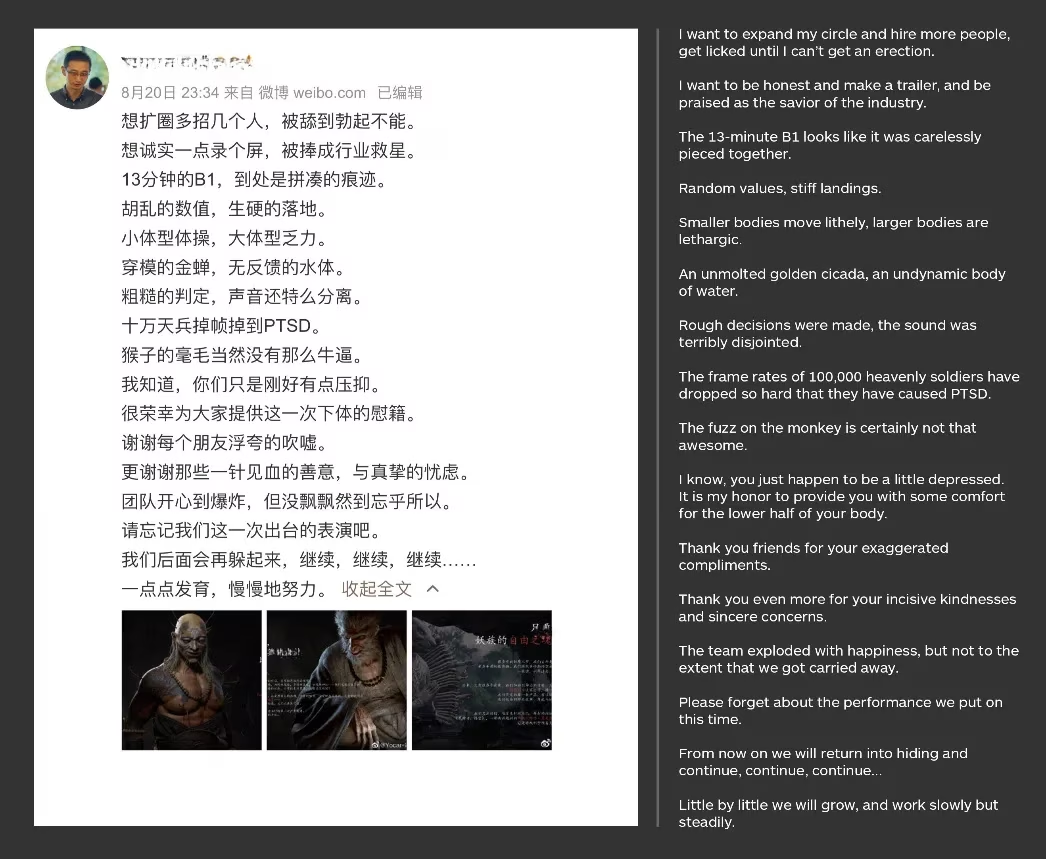
To many within China's gaming circles, this language was defended as unremarkable—the coarse patois of a walled-off internet. But for a growing number of women players and developers, it was a clear signal: this workshop, for all its craftsmanship, was not built with them in mind. The studio's logo itself, noted by netizens to resemble a sperm cell, became a silent, ironic emblem of this ethos. Jen, a Chinese game designer, told me her high expectations curdled into disappointment upon discovering these remarks. "I admire their dedication," she said, "but they have a notably negative reputation in the eyes of many female players."
The Wider Landscape: An Uphill Pilgrimage
This controversy does not exist in a vacuum. It is a single, stark boulder on a steep mountain path that Chinese women in gaming have been climbing for years. The landscape is fraught:
| Challenge | Description |
|---|---|
| Cultural & Governmental Hostility | A historical culture of sexism meets government crackdowns on feminist organizing and online discourse (e.g., #MeToo). |
| Toxic Online Spaces | Nearly half of China's gamers are women, yet gaming rhetoric is often hostile, making them feel unsafe. |
| Industry Exclusion | Until recently, games were marketed almost exclusively to men. While otome games have opened the market, women in development roles remain scarce and often invisible. |
| Corporate Toxicity | Examples abound, like the CEO of Duoyi Games allegedly laying off women to avoid "another feminist bitch," with no professional blowback. |
This context makes the backlash against Game Science a microcosm of a larger struggle. When female players voiced their hurt, declaring "Hey, you basically made it clear that you don't want us to play your game," the counter-attack was fierce. They were met with a barrage of harassment and arguments that their economic and cultural relevance was negligible. "AAA games and most games actually don’t need female players," one comment read. Another celebrated: "There are actually no female players! Let’s throw flowers, this is great!" The message was clear: the dream of Wukong was a masculine pilgrimage, and women were interlopers in this sacred journey.
The Inflection Point: A Global Stage Awaits
Now, in 2026, Black Myth: Wukong stands on the precipice of global release. Its technical artistry is undeniable, a towering pagoda of visual and gameplay ambition. Yet, its creators are being thrust onto an international stage that may scrutinize their past with a less forgiving lens. The studio finds itself in a dilemma as intricate as a puzzle-box: apologize and risk alienating its core, defensive fanbase, or stay silent and risk condemnation from a global audience increasingly aware of creators' values.
There is a profound irony here, one that sits heavy in my mind. Journey to the West is a tale of redemption, discipline, and overcoming base instincts. One of its pilgrims, Zhu Bajie, is literally banished for sexual harassment. And yet, the compassionate force who repeatedly saves the journey is Guanyin, the goddess of mercy. As researcher Rui Zhong wryly noted, it's often Guanyin who cleans up the messes made by the male protagonists—a dynamic that echoes uncomfortably with the expectation for women to quietly endure toxicity. Will Game Science acknowledge this irony? Will Guanyin even appear in their version of the tale?

For developers like Cathy, the choice is painfully personal. "I would probably still play the game because it's really important for the industry," she confessed, "but I wouldn't promote it." The studio's continued silence, its failure to directly address or apologize, feels to many like a final, closed door.
As I look back at that opening vision—the bard, the chase, the temple—I see two realities superimposed. One is the luminous dream of a masterpiece, a cultural landmark years in the making. The other is the shadowed workshop where that dream was forged, a place where respect was a missing ingredient. The game's quality may yet be a monolith that stands for ages, but the shadows it casts are long and shaped by choices made over a decade. For countless female players and developers, the ultimate trial of Black Myth: Wukong is not found in its boss battles, but in the painful pilgrimage of deciding whether to support an art that seems to disdain their very presence in its audience. The dream is breathtaking, but for many, the cost of admission feels like a piece of their own dignity. In the end, the most epic journey may be the one happening outside the game, as a community grapples with what it chooses to celebrate, and what it must, in good conscience, condemn.
Leave a Comment