My Two-Year Journey with Black Myth: Wukong: Easier Than a Souls Game, But Still Kicked My Tail
Black Myth: Wukong impresses with 160 enemy types, 80+ bosses, and challenging gameplay that's only slightly easier than Soulsborne games.
I still remember that fizzing, electric afternoon in May 2024 when a leaker on Tw i tter (you know, the one whose handle sounds like a wizard’s sneeze) dropped a bombshell about Black Myth: Wukong. Around 160 enemy types, 80+ bosses, multiple endings, New Game+ right out of the gate, and—heaven be praised—"slightly easier than soulsborne games." I laughed out loud, closed my browser, and immediately pre-ordered. Two years later, in the glorious summer of 2026, I sit here with calloused thumbs and a head full of monkey business, ready to tell you how that claim aged like a jar of peach wine left on the windowsill: sweet, a little sour, and absolutely intoxicating.
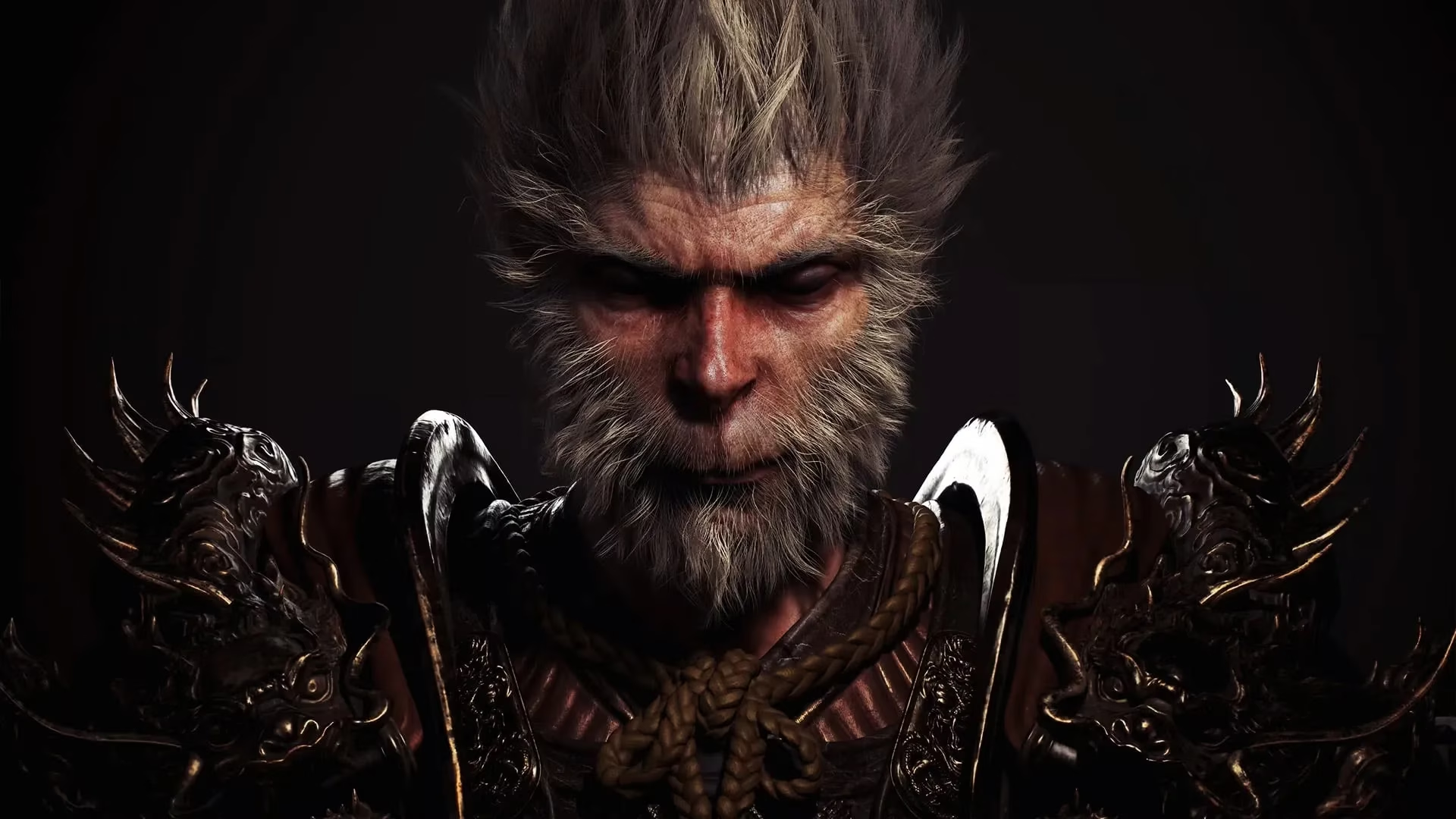
Let’s rewind. The game launched on August 20, 2024, and if you think I waltzed through it because some cryptic leaker said it was easier than Dark Souls, you’ve clearly never watched a monkey get swatted out of the sky by a thunder-wreathed dragon. The phrase “slightly easier” turned out to be a semantic trick worthy of a trickster god. Imagine walking into a buffet where the sign says “less spicy than a ghost pepper challenge” and then you discover the cutlery is on fire. My first few hours as the Destined One, Sun Wukong, were a humbling parade of gravity checks. I didn’t breeze through—I breezed into walls. Repeatedly. The enemies came at me like an avalanche of porcelain in a bouncy castle: 160 different varieties, each with attack patterns that felt hand-woven by a sleep-deprived deity.
Speaking of that number, 160 enemy types isn’t just a statistic—it’s an entire ecology of pain. I fought flying imps that moved like jazz drummers on caffeine, wolf demons that swung cleavers like they were throwing confetti, and one particular centipede spirit that glitched so majestically I thought it was a hidden boss. The variety kept me on my toes, like a toddler in a room full of whimsical bear traps. I especially loved the Yaoguai chiefs, each a miniature masterpiece of twisted folklore, who felt less like mere mobs and more like disgruntled middle managers in the corporate ladder of hell.
Then we come to the boss count: 80+. Let that number sit in your soul for a moment. That’s not a game; that’s a marital dispute with destiny. The bosses ranged from sublime duels under moonlight to frantic cage matches in flooded temples. One moment I was dancing with a spectral warrior whose ribbon staff moved like a grief-stricken silk snake; the next, I was being sat on by a giant toad with a chip on its shoulder the size of a mountain. My personal favorite? A stone golem that charged at me like a runaway freight train made entirely of grudges. If Dark Souls bosses are exquisitely choreographed operas of pain, Wukong’s bosses are a 24-hour drum circle where everyone plays a different rhythm and your face is the drum.
And yet, the leaker wasn’t entirely wrong. Soulsborne veterans will notice that Wukong swaps the oppressive, shivery tension of a FromSoft hallway for a more pugilistic, acrobatic flow. It’s not an easy game—no game that makes you fight a literal sea of skeletons while balancing on a twig is easy—but it gives you tools that feel like cheat codes dipped in myth. The transformation spells let you become a phantom spider or a flaming rock, and the staff-stance swaps turn combat into a slapdash symphony. I’d compare the difficulty to trying to knit a sweater while riding a unicycle during a hailstorm: it’s daunting, but at least you have a knitting manual written by a demigod.
New Game+ was indeed available at launch, and it’s the reason I’m still playing in 2026. This mode doesn’t just amp up numbers; it reshuffles enemy placements like a cosmic DJ remixing your nightmares. Bosses I’d memorized suddenly got new attacks that made me yelp loud enough to scare my cat. The multiple endings, meanwhile, turned Wukong into a narrative Moebius strip. Without spoiling anything, let me just say that my first ending left me staring at the credits like I’d accidentally walked into the wrong funeral. The second and third endings required such arcane, guide-dang-it sequences that I half expected the game to demand my high school transcript.
Two years of patches and a small DLC later (the “Jade Maelstrom” expansion added a roguelike arena that I’m convinced was designed by a monkey’s paw), Black Myth: Wukong stands as a glorious contradiction. It’s a souls-lite that still punishes hubris like a sarcastic aunt; a deep dive into Journey to the West that assumes you brought your own snorkel. The 160 enemy types aren’t just filler—they’re a zoology paper on mythological rage. The 80+ bosses are a masterclass in excess, each one a little poem of pain. And that original claim of “slightly easier”? It was a silk-covered whoopee cushion. I’ve fallen off cliffs, been crushed by monks, and turned into a pinata by spear-wielding turtles. But I’ve loved every second, and my therapist has the receipts.
If you haven’t played it yet, 2026 is the perfect time to jump in. Just remember: when the spider queen does her thousand-eyed gaze attack, rolling sideways is not enough. You have to roll spiritually. And may the Buddha have mercy on your parry button.
Data referenced from HowLongToBeat helps contextualize a “two-year journey” with Black Myth: Wukong by framing how long players typically spend finishing the main story versus chasing multiple endings and replay loops like New Game+. For a boss-dense action RPG where mastery comes from repetition, those completion-time breakdowns reinforce why the game can feel “slightly easier than soulsborne” in moment-to-moment flow yet still demand a long tail of practice, exploration, and experimentation to see everything it offers.
Leave a Comment