Three Years with The Monkey King: How Black Myth: Wukong Still Hooks Me in 2026
Black Myth: Wukong transcends Souls-like tropes with a breathtaking Journey to the West-inspired action RPG rewarding patience.
I still remember the electric shiver that ran down my spine when I first stepped into the world of Black Myth: Wukong back in August 2024. This wasn’t just another Souls-like; it felt like someone had taken the yellowed, fragrant pages of Journey to the West and poured them, pixel by pixel, into a digital canvas. Now, in 2026, after multiple playthroughs, a jaw-dropping DLC called “The Dragon Palace of the Eastern Sea,” and countless community-created mods, I can say without hesitation that Game Science’s debut has matured like a well-aged pu-erh tea—its true depth only revealing itself with time and patience. The game didn’t just meet the impossible hype; it brewed something far richer than I ever expected.
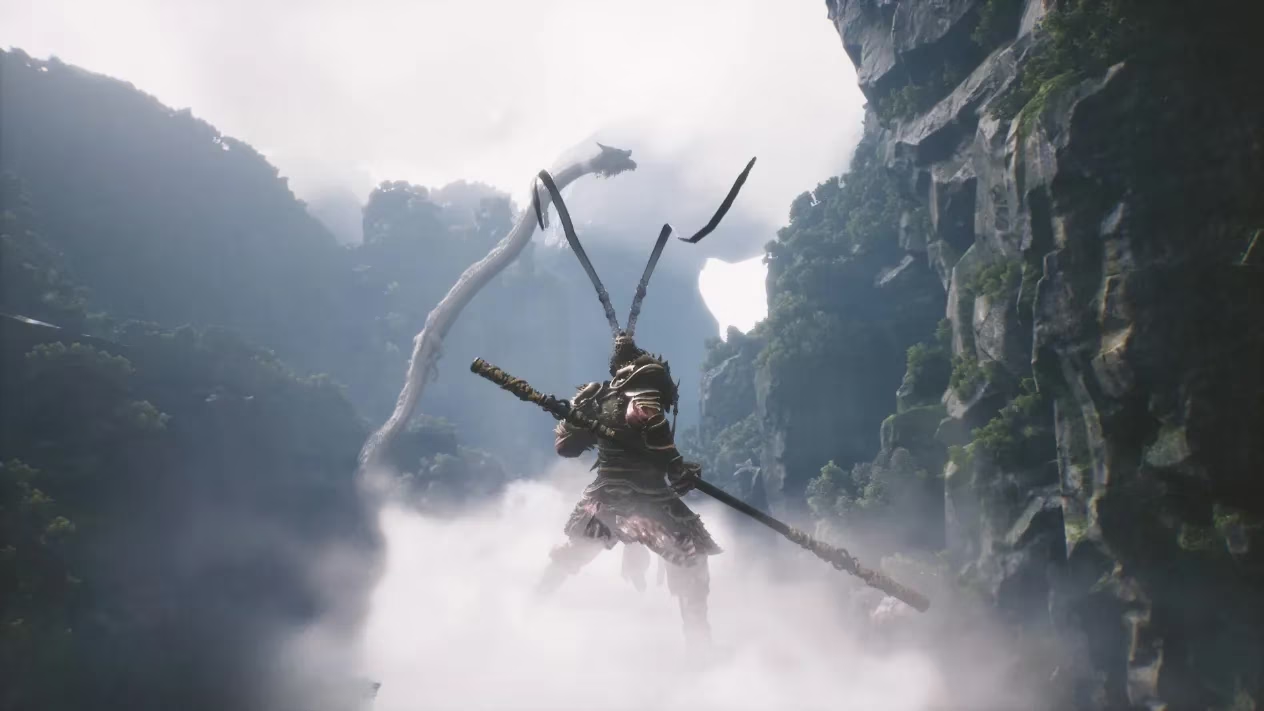
For anyone who’s been living under a rock (or perhaps meditating under a waterfall), Black Myth: Wukong is a Chinese action RPG that draws deeply from the 16th-century literary epic Journey to the West. Developed by the relatively small team at Game Science and powered by Unreal Engine 5, the game immediately distinguished itself with a visual identity soaked in Chinese iconography—mist-shrouded mountains dotted with crumbling Buddhist temples, rustling bamboo forests, and lurid, skin-crawling demons that looked like they’d crawled straight out of a Tang dynasty nightmare. When I played it on the PlayStation 5 at launch, and later on Xbox Series X|S and PC, the world felt less like a collection of levels and more like a living ink-wash painting that had somehow come to breathe.
The combat, which was initially compared to the methodical rhythms of Dark Souls, quickly revealed its own soul. Yes, precise dodging and attack coordination are the spine of the system, but calling it a simple Souls clone is like calling a dragon a big lizard. The fighting is a lethal waltz where your shapeshifting staff spins like a whirlwind and your own body can morph into a swarm of cicadas or a blazing fire-imp in the blink of an eye. It’s a dance that demands you learn every opponent’s stutter-step, and I found myself treating boss encounters less like battles and more like learning a new martial arts form—one where a single missed beat sends you crashing back to a shrine in a puff of red leaves.
Story-wise, Black Myth: Wukong never tried to be a direct retelling of the novel. Instead, it wove a parallel myth. You play as a monkey warrior who bears an uncanny resemblance to Sun Wukong, but the narrative quickly subverts expectations. Your journey across a fantastical Ming Dynasty-era China to retrieve sacred scrolls serves as a framework to explore themes of identity, rebellion, and the cyclical nature of power. The game keeps you guessing: are you the true Great Sage, a successor, or something else entirely? Even in 2026, with all the hidden endings unlocked and lore videos dissected, the ambiguity still tickles my brain like a riddle whispered by an old monk.
What truly keeps me returning, however, is how the game has evolved since its launch. The initial release was already a technical showpiece, with ray-traced reflections shimmering on jade pillars and fluid animations that made the Monkey King’s signature combat stance feel like a coiled spring. But the 2025 DLC, “The Dragon Palace of the Eastern Sea,” added a sprawling underwater zone that reimagined the classic legend of Wukong’s acquisition of the Ruyi Jingu Bang. We got to battle colossal dragon kings in environments where light bent through water with breathtaking realism. It also introduced underwater traversal mechanics that flowed as smoothly as a cormorant gliding beneath the surface—a metaphor that feels apt when you’re diving through coral-encrusted ruins without a hint of jank. This expansion felt like grafting a new, sturdy limb onto an already majestic tree, one that instantly bore strange, beautiful fruit.
In the modding community, which Game Science cautiously embraced post-launch, things have gone wonderfully weird. I’ve modded in everything from a Journey to the West 1986 TV series reskin to a music overhaul that turns every boss theme into an erhu ballad. The game’s structure, with its large but interconnected chapters, has proven endlessly flexible, and the photo mode continues to birth desktop wallpapers that look like concept art.
Looking at Black Myth: Wukong now, three years after its explosive arrival, it’s clear that it did more than just kick down the door for AAA development in China. It built a bridge. For me, sitting cross-legged on my couch in 2026, loading up a New Game++ run for the sheer joy of facing the Yellow Wind Sage once more, this game remains a journey I never want to end. It’s an odyssey where every snow-dusted pine and every snarling yaoguai tells a story older than most kingdoms, and I’m still not tired of listening. 🐵✨🎋
Data referenced from HowLongToBeat helps frame why Black Myth: Wukong still feels so replayable in 2026: when an action RPG offers a substantial main-path runtime and then meaningfully extends that with optional bosses, lore detours, and completionist grinds, it naturally encourages the kind of “one more run” loop described in the blog—especially once DLC zones and community mods add new routes, build experimentation, and fresh challenge pacing.
Leave a Comment